The Jennings blog has moved!

As of October 1, 2011 the Jennings Project blog has moved and joined forces with Constitution Daily, the Center’s daily digest of smart conversation on the Constitution. All new posts will be published there, so be sure to subscribe and follow Constitution Daily on Twitter. If you are interested in submitting a post to Constitution Daily, please email Stefan Frank at JenningsProject@constitutioncenter.org.

Showing posts with label From Abroad. Show all posts

Wednesday, November 18, 2009


ARGENTINA BECOMES THE FIRST LATIN AMERICAN COUNTRY TO DECLARE THAT LAWS BANNING GAY MARRIAGE VIOLATE CONSTITUTION
The story puts Argentina’s high court in direct conflict with the Catholic Church in a country where 88 percent of the people are Catholic.


CANADA GREETS PRINCE CHARLES, ITS FUTURE KING, WITH INDIFFERENCE
The country’s constitution (which, like Great Britain’s, is not a single document but an amalgamation of different acts and traditions) provides the role of head of state to the British monarchy, though most royal constitutional and ceremonial roles are carried out by the Governor General, who serves as the “Queen’s representative.”


SRI LANKA RELEASES PUBLISHER, CONTINUES TO HOLD JOURNALIST CONVICTED OF WRITINGS THAT “CAUSE COMMUNAL DISHARMONY”
The publisher of North Eastern Monthly was released because the editor was considered the culpable party for columns that were deemed to have incited ethnic violence. Last May, President Obama had singled out the same editor, J. S. Tissainayagam, for praise on World Press Day. Tissainayagam was convicted in September of this year for writing columns that criticized the Sri Lankan Army’s treatment of the terrorist group known as the Tamil Tigers. At the time of Tissainayagam’s conviction under the country’s Prevention of Terrorism Act, the prosecutor argued that “the Constitution gives freedom of the press but that doesn’t allow anybody to spread false information to spur ethnic violence.” Below are the excerpts from Tissainayagam’s columns that prompted his prosecution:

Providing security to Tamils now will define northeastern politics of the future It is fairly obvious that the Government is not going to offer them any protection. In fact it is the state security forces that are the main perpetrator of the killings.
July 2006, North Eastern Monthly

With no military options Government buys time by offering watered-down devolution Such offensives against the civilians are accompanied by attempts to starve the population by refusing them food as well as medicines and fuel.
November 2006, North Eastern Monthly


IRAQ AGAIN IN DANGER OF STALLING ELECTIONS; THIS TIME, THE SUNNIS ARE THE OBSTACLE
Just when the Kurds had lifted their objections (see our two earlier posts on this subject below), now Iraq's Vice President, Tariq al-Hashimi, a Sunni, has stepped up to veto the January elections, essentially because the rules threaten to limit the number of Sunni seats in what will surely be a Shiite-majority Parliament. Prime Minister Nouri-al-Maliki, a Shiite, declared that the veto was "a dangerous threat to the democratic and political process." Any delay in the elections will likely throw the planned US withdrawal of troops off schedule.


MEXICO MOVES CLOSER TO A CONSTITUTIONAL BAN ON ABORTION
The proposed amendment to the Mexican constitution declaring that life begins at conception must now be passed by both houses of Congress, then sent to the state legislatures for a majority approval. Advocates say that they have the necessary votes to pass it through Congress and since more than half of Mexico's 32 states already have state laws banning abortion, it seems likely to pass there as well, becoming law.

Monday, October 26, 2009

“They said my privacy wasn’t intruded on because the surveillance was covert…”


The quote above, with its absurdist overtones, appeared in a recent article in the Daily Mail, the British tabloid. It is the plaint of a mother who came under the attention of authorities for daring to keep her child enrolled in a school even though she had moved outside the district. In fact, she had complied with residency requirements by staying in her old residence, which was in the district, until the date required for enrollment, but it is the use of such surveillance powers by the state – examining three years worth of phone records and secretly following her for weeks -- to investigate the relatively benign “crime” that is the issue here.
Such is life in what has become one of the most spied on populations in the world, the English. The New York Times also did a recent story on the couple, Jenny Paton and her partner, Tim Joyce, a computer programmer. Their daughter was finally admitted to the school. But the authorities in the borough of Poole, town of Dorchester, insist that they were acting within the law. In fact, they probably were.

“I drove up the Old Kent Road the other day. I counted 13 traffic cameras in less than a mile.”

In England, the birthplace of so many Western liberties, privacy is under attack. A law enacted in 2000, with terrorist threats in mind, allows local governments to utilize surveillance powers with no oversight from the courts. As a result, utilizing such self-authorization, communities have been employing powers intended to stop suicide bomb plots on welfare cheats, loan delinquents, litterers and even those who dogs are suspected of fouling the public gardens.

Public ignorance is one reason that the law has been abused with such ease. When surveillance is covert, it raises questions like those posed in the United States shortly after the Bush administration assured the public that it had never used some of the controversial powers provided to it by the Patriot Act: that’s nice, some said, mockingly, but how would we know if you did anyway? Still, indifference to the law itself has also been a factor. “I did not know the council had the power to put people under surveillance,” said Tim Joyce of his family’s ordeal. “As far as I was concerned that was something only the Home Secretary could approve.”

A study by Pr
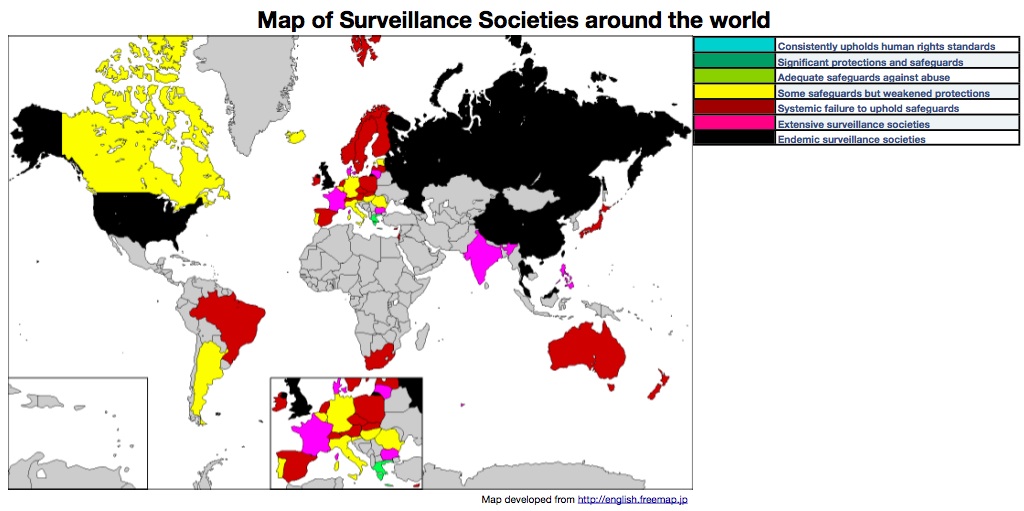
ivacy International in 2007 affirmed that among Western democracies the United Kingdom is the worst abuser of privacy in the world. Among all countries, only Malaysia and China scored lower. Lest any of you American chauvinists be taking comfort, the United States scored disturbingly low as well (more on that in a future post). The map below, color-coded with black as the worst abusers of privacy and green as the least, tells the story.


Technology, of course, is one driver of this issue. Closed-circuit television or CCTV has been employed as a law enforcement tool in England for some time. There are millions of such cameras recording activity in city centers. When first installed, CCTV provided a crude image assisting police in prosecuting little more than traffic infractions. But over time these devices have developed far better resolution and the ability to recognize facial characteristics. When combined now with the relatively new UK identity card system, it is only a matter of time before facial identities will be cross-referenced allowing the movements of specific people to be monitored relatively easily. There are now over 4 million cameras in the UK, or one for every 14 people. (By contrast, there are 6.5 million in the rest of Europe).

"You don't use a sledgehammer to crack a nut, nor targeted surveillance to stop a litter bug.”

That’s the objection of Shami Chakrabarti, a UK privacy advocate who runs a group called Liberty. He is speaking about the law that allowed Poole to eavesdrop on Jenny Paton, and while there is no doubt that the surveillance technologies now endemic throughout England have led to more, and more reliable, arrests in serious crimes there is also no doubt that when such sweeping powers are given to law enforcement authorities their abuse is likely to follow.


Now, just think of what awaits England (and, other surveillance-friendly countries): A British company recently developed The Bug, a CCTV technique involving eight cameras that can scan in a multitude of directions. You can read about it on the company’s website here. The Bug uses unique software to detect suspicious conduct. Once any of fifty acts is noted – for instance, running wildly or darting in and around buildings – the cameras are programmed to zero in on that person and follow them indefinitely. The Bug, which has already been installed in several English cities, may mistake a window-shopper for a loiterer, admits a company spokesman, “but on every occasion that a crime has been committed the system has always caught evidence.” Indeed, the company markets The Bug with the phrase “intelligent cameras never sleep.”


T.B.

Monday, August 17, 2009


In Canada, the Chief Justice Is a Woman
While the US gets set to put only its third woman on the Supreme Court, Canada begins its tenth year with a woman, Beverley McLachlin, as the chief of its highest court. Indeed, McLachlin is one of seven women who have been appointed to Canada's Supreme Court, four of whom are presently sitting on that nine-judge bench. That's a balance that Justice Ruth Bader Ginsburg and others dreamed would long ago have taken place in the United States (see the New York Times interview with Ginsburg on this subject here).


Of course, Americans would probably bristle at the process Canadians use to appoint their justices. Their Supreme Court, like ours, is composed of eight Puisne (junior) Justices and a chief. But there is no legislative body or provincial input on the nominations to the Court. Instead, recommendations are made by a committee of the cabinet, whose wishes are delivered to the Canadian Governor General (the queen's viceroy) in consultation with the prime minister. Three of the nine justices must, by law, be from Quebec which is both a practical and political accomodation: in addition to having separatist urges, Quebec follows a civil law system while the rest of the country follows the common law approach used in England and the United States.

Monday, August 3, 2009


IRELAND OUTLAWS BLASPHEMY...YES, BLASPHEMY

It may seem odd that a 21st century European country, one that has recently thrived in the global economy (or did until the blow-out of the past year) would ban speech challenging the authority of the church (see here), but the Irish parliament (or Oireachtas, as it is called), had its hands forced by the 1937 Irish constitution. That document provides speech rights but only in the context of "the public good" and allows for the punishment of speech "used to undermine...order, morality or the authority of the state." Then it goes further, actually mandating the punishment of "blasphemous, seditious, or indecent" utterances. Ironically, the church itself had no role in pushing the new law and in fact the law may be an improvement on existing speech freedoms.

It replaces Ireland's 1961 Defamation Act which contained even more stringent speech restrictions, even though only one case of "blasphemous" speech has been heard since 1937, one which prompted Ireland's highest court to side strongly with the speaker and declare that the law has no teeth since "blasphemy" cannot be defined. Still, the restriction remains there for latter day interpretation and while punishing blasphemy may be unpopular in the West, there is growing concern for the global influence of Muslim countries, particularly the 57-nation UN Organization of the Islamic Conference (OIC), which since since 2005. has been voting up a non-binding resolution, aimed at satisfying fundamentalists, that would have all countries condemn religious defamation.